Why Modern Software Architecture is Evolving in 2026
Software architecture is undergoing one of the biggest transformations in modern technology history. Traditional monolithic systems that once powered startups and enterprises are now struggling to handle the demands of scalability, rapid deployment, distributed teams, AI workloads, and cloud-native infrastructure.
In 2026, companies are no longer designing applications only for functionality. They are designing systems for scalability, resilience, automation, and continuous evolution. This shift is driving the rise of modern software architecture patterns such as microservices, micro-frontends, event-driven systems, containerization, Kubernetes orchestration, and AI-powered automation.
Modern engineering teams are now prioritizing modular systems that can scale independently while improving deployment speed, developer productivity, and infrastructure reliability.
The Problem with Traditional Monolithic Systems
For years, monolithic architecture was the default approach for building applications. Everything — frontend, backend, APIs, business logic, and databases — existed inside a single tightly coupled codebase.
While monoliths were easier to build during the early stages of development, they introduced major challenges as systems scaled:
- Slower deployments
- Difficult scalability
- Tight coupling between services
- High infrastructure dependency
- Increased debugging complexity
- Team coordination bottlenecks
- Large and difficult codebases
As modern applications began serving millions of users globally, monolithic systems started becoming operational bottlenecks.
The Rise of Microservices Architecture
One of the biggest shifts in modern backend engineering is the move from monoliths to microservices.
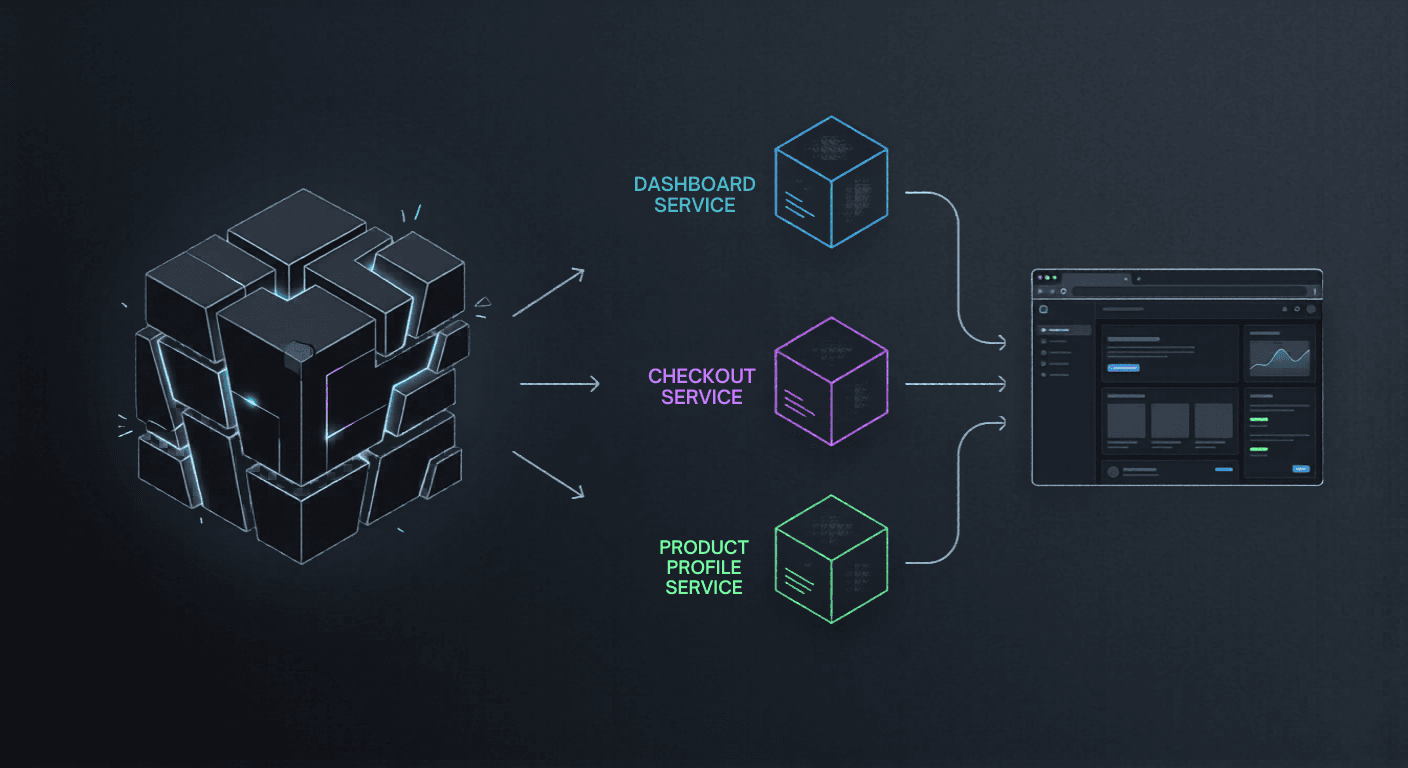
Microservices break applications into smaller independently deployable services where each service handles a specific responsibility.
For example:
- Authentication service
- Payment service
- Notification service
- Analytics service
- AI inference service
This architecture allows engineering teams to scale services independently while reducing deployment risks.
Microservices also improve:
- Fault isolation
- Scalability
- Team autonomy
- Technology flexibility
- CI/CD efficiency
This is one of the primary reasons why modern SaaS and enterprise systems are rapidly adopting distributed architectures.
Why Frontend Architectures are Also Changing
Backend systems are not the only components evolving. Frontend architectures are also shifting toward modular development.
Modern companies are increasingly adopting micro-frontends, where frontend applications are divided into independently managed modules.
This allows:
- Independent frontend deployments
- Faster feature releases
- Better scalability for frontend teams
- Reduced build complexity
- Improved developer productivity
As organizations scale, frontend modularization becomes essential for maintaining agility across multiple engineering teams.
Cloud-Native Infrastructure is Becoming Standard
Modern applications are now designed directly for cloud environments instead of traditional server-based hosting.
Cloud-native systems rely heavily on:
- Containers
- Kubernetes orchestration
- Auto-scaling infrastructure
- Distributed databases
- Infrastructure as Code (IaC)
- CI/CD automation
This enables businesses to deploy globally scalable applications with improved uptime and operational efficiency.
Containerization technologies such as Docker have become essential because they ensure deployment consistency across development, staging, and production environments.
The Growing Importance of Event-Driven Systems
Traditional synchronous systems often struggle under high-scale workloads. Modern architectures are increasingly moving toward event-driven systems where services communicate asynchronously using events and message queues.
This architecture improves:
- Scalability
- Reliability
- System decoupling
- Real-time processing
- Fault tolerance
Event-driven systems are becoming critical for AI systems, fintech platforms, SaaS applications, and large-scale automation platforms.
AI is Accelerating Architectural Evolution
Artificial intelligence is introducing entirely new infrastructure demands. AI workloads require scalable compute systems, distributed processing, low-latency APIs, vector databases, and real-time orchestration pipelines.
As a result, organizations are redesigning their architectures to support:
- AI agents
- Workflow automation
- Real-time inference systems
- Multi-agent orchestration
- AI-native SaaS products
Modern architecture is no longer only about serving users — it is increasingly about enabling intelligent autonomous systems.
Why DevOps is Now a Core Engineering Requirement
Development and operations are no longer separate domains. Modern software delivery depends heavily on DevOps practices that automate deployments, monitoring, scaling, and infrastructure management.
Companies are investing heavily in:
- CI/CD pipelines
- Infrastructure automation
- Observability systems
- Monitoring platforms
- Security automation
This helps organizations reduce downtime while accelerating release cycles.
Our Engineering Experience
While working on scalable application architectures, we observed that tightly coupled systems significantly slowed deployment cycles and increased operational complexity as products grew. Managing frontend and backend changes inside monolithic environments often created dependency conflicts, deployment bottlenecks, and scaling limitations.
To improve scalability and deployment efficiency, we gradually shifted toward modular architectures, containerized deployments using Docker, and independently deployable services. This transition improved development workflows, reduced deployment inconsistencies, and made infrastructure scaling more manageable.
As AI automation systems and distributed workflows became more important, adopting modern architecture patterns became essential rather than optional.
The Future of Software Architecture
Modern software architecture is moving toward highly modular, scalable, and intelligent systems. Businesses are prioritizing architectures that support:
- Independent scalability
- Faster deployments
- Global infrastructure
- AI-native workflows
- Real-time processing
- Automated operations
The future belongs to systems that are flexible, distributed, cloud-native, and automation-driven.
Organizations that continue relying entirely on traditional monolithic approaches may struggle to compete with the speed and scalability required in modern software ecosystems.
Final Thoughts
Software architecture in 2026 is evolving far beyond traditional application development. Modern engineering teams are designing systems not only for functionality, but for scalability, resilience, automation, and continuous delivery.
The rise of microservices, micro-frontends, Kubernetes, cloud-native infrastructure, AI systems, and event-driven architectures reflects the growing demand for modular and scalable software ecosystems.
As businesses continue scaling digital products globally, modern architecture patterns will become the foundation of future-ready software systems.
Related Blogs
- Why Monoliths are Dying: Moving to Micro-Frontends in 2026
- Microservices vs Monoliths: Why Backend Architecture is Evolving in 2026
- Docker vs Virtual Machines: Why Containers Took Over
- Why Kubernetes is Becoming Essential for Scalable Applications
- The Rise of Edge Computing in Modern Web Applications