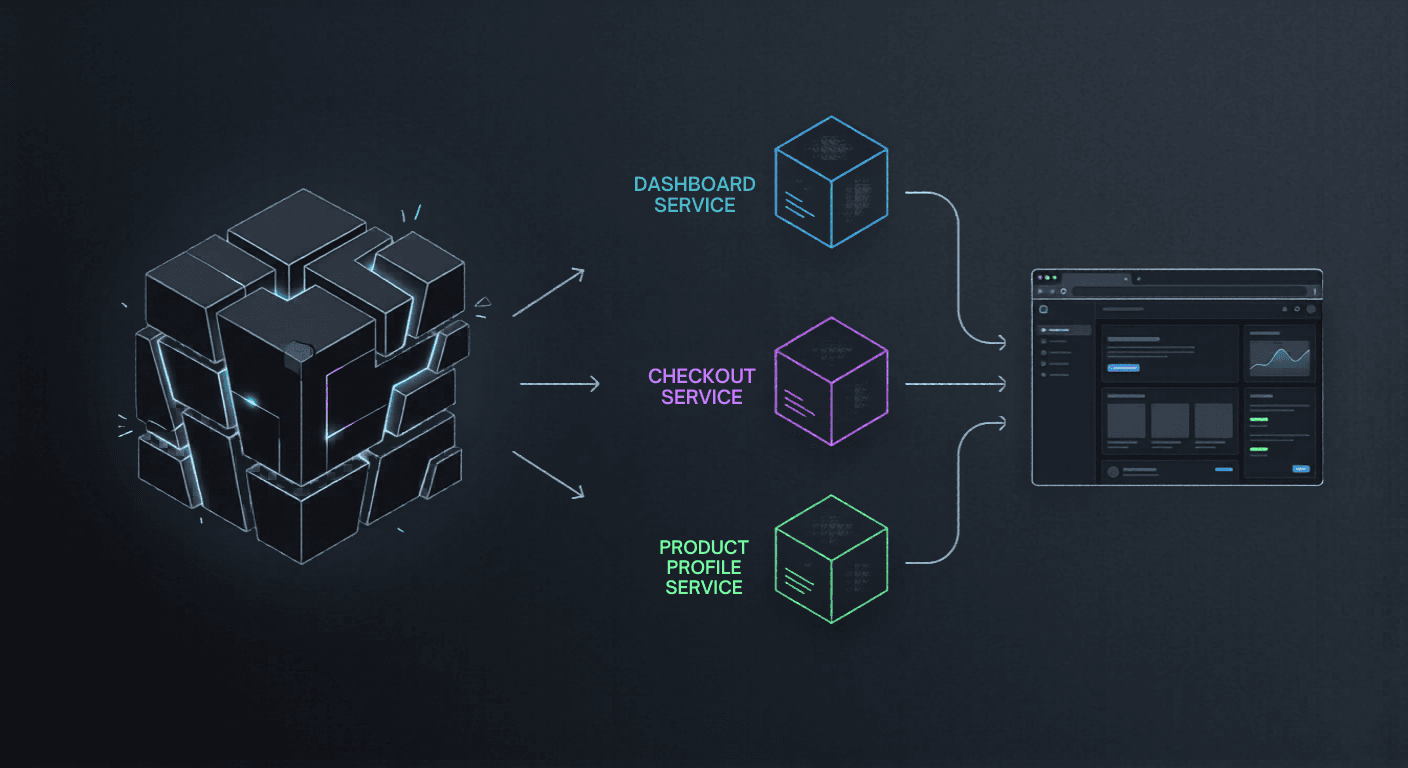
Why Monoliths are Dying: Moving to Micro-Frontends in 2026
For years, monolithic frontend architectures dominated web development. A single codebase, one deployment pipeline, and tightly coupled components were once considered efficient. But in 2026, the landscape has changed dramatically. As applications grow larger, teams become distributed, and deployment speed becomes critical, monoliths are rapidly losing relevance.
Modern businesses now demand agility, scalability, and independent development workflows. This shift has pushed organizations toward Micro-Frontend Architecture, a frontend approach inspired by microservices.
What is a Monolithic Frontend?
A monolithic frontend is a single large application where all UI components, business logic, routing, and state management exist within one tightly connected codebase.
While this approach works well for small applications, it creates serious challenges as products scale:
- Slow deployment cycles
- Difficult team collaboration
- Large bundle sizes
- Increased risk during updates
- Dependency conflicts
- Reduced scalability
In enterprise-level systems, even a small UI change can require rebuilding and redeploying the entire application.
Why Companies are Leaving Monoliths Behind
1. Faster Team Collaboration
Modern development teams work independently across multiple features and products. In a monolith, teams often block each other because everyone works within the same repository and deployment pipeline.
Micro-frontends solve this by allowing teams to own specific parts of the application independently.
For example:
- Payments team manages checkout UI
- Analytics team manages dashboards
- Marketing team manages landing pages
- Support team manages customer portals
Each team can deploy updates without affecting others.
2. Independent Deployments
One of the biggest limitations of monoliths is the “all-or-nothing deployment” model. Even a tiny fix requires redeploying the entire frontend application.
Micro-frontends allow independent deployments where only the updated module is released. This dramatically reduces deployment risks and downtime.
Benefits include:
- Faster release cycles
- Reduced rollback impact
- Easier hotfixes
- Better CI/CD pipelines
3. Technology Flexibility
In monolithic systems, migrating from one framework to another becomes extremely difficult.
Micro-frontends allow organizations to use multiple technologies within the same application. One team can use React while another uses Vue or Angular, depending on project requirements.
This flexibility helps enterprises modernize gradually instead of rebuilding entire platforms from scratch.
4. Improved Scalability
As frontend applications grow, monoliths become harder to maintain. Build times increase, debugging becomes complex, and performance optimization becomes challenging.
Micro-frontends break applications into smaller independent modules, making scaling significantly easier.
Large companies such as e-commerce platforms, SaaS products, and fintech applications are increasingly adopting this approach to handle millions of users efficiently.
5. Better Fault Isolation
In monolithic systems, a single bug can impact the entire application.
Micro-frontends isolate failures to specific modules. If one section crashes, the rest of the application can continue functioning normally.
This improves system reliability and user experience.
Popular Micro-Frontend Approaches in 2026
Several architectures are becoming industry standards:
Module Federation
Webpack Module Federation remains one of the most popular solutions for sharing components across applications dynamically.
Single-SPA
A framework for orchestrating multiple frontend frameworks into one unified application.
Edge-Based Composition
Modern cloud platforms now assemble frontend modules at the CDN or edge layer for improved performance.
Server-Side Composition
Frontend fragments are combined server-side before reaching the client.
Challenges of Micro-Frontends
Despite their advantages, micro-frontends are not perfect. Organizations must handle:
- Shared dependency management
- Cross-team coordination
- Consistent design systems
- State synchronization
- Performance optimization
Without proper architecture planning, micro-frontends can become fragmented and difficult to manage.
When Should You Move to Micro-Frontends?
Micro-frontends are ideal when:
- Multiple teams work on the same platform
- Your application is scaling rapidly
- Deployment speed is critical
- You need independent feature ownership
- Different technologies must coexist
However, small startups or simple applications may still benefit from monolithic architectures due to lower complexity.
The Future of Frontend Architecture
In 2026, frontend architecture is evolving toward modular, distributed, and independently deployable systems. Businesses are prioritizing speed, scalability, and developer productivity more than ever before.
Micro-frontends are no longer just a trend — they are becoming the default architecture for enterprise-scale applications.
Organizations that continue relying on large monolithic frontends may struggle with slower innovation, deployment bottlenecks, and increasing maintenance costs.
The future belongs to modular frontend ecosystems where teams can build, deploy, and scale independently.
Final Thoughts
Monolithic frontends played a crucial role in the evolution of web development, but the demands of modern applications are pushing companies toward more flexible architectures.
Micro-frontends provide the scalability, agility, and independence required for today’s fast-moving digital products. While they introduce new architectural challenges, their benefits often outweigh the complexity for growing organizations.
As we move further into 2026, the transition from monoliths to micro-frontends is becoming less of an option and more of a necessity for scalable modern applications.