RAG for Business Knowledge: Build an AI Assistant That Shows Its Sources
A team member asks a simple question: which version of the onboarding checklist should we use? The answer exists somewhere, but it is scattered across folders, messages, and documents with similar names.
A business knowledge assistant can help people find and interpret that information. The useful starting point is the quality and ownership of the documents, rather than the appearance of the chat window.
What Is Retrieval-Augmented Generation?
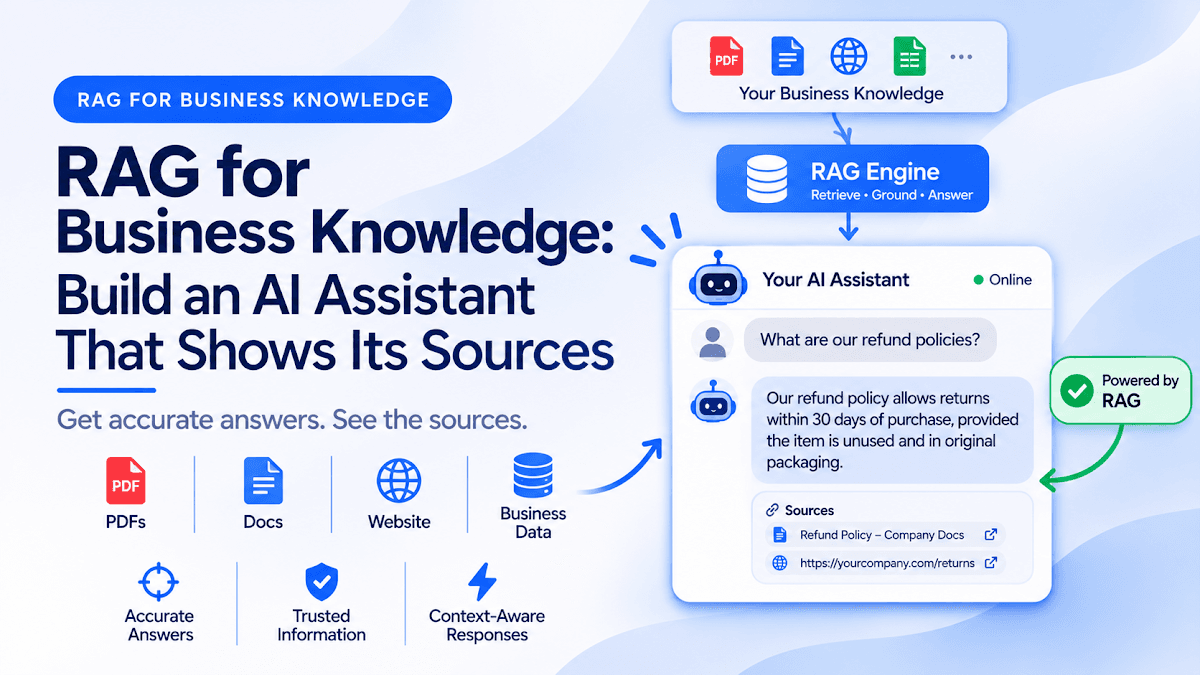
Retrieval-augmented generation, usually shortened to RAG, gives a language model relevant material retrieved from an external knowledge source. Microsoft's guidance describes it as a way to ground responses in proprietary content, while noting challenges around query understanding, access to multiple sources, limited context, and response time.
Retrieval can improve the evidence available to an assistant. It does not guarantee that every answer is correct, complete, current, or appropriate for the person asking.
Choose a Narrow First Use Case
A proposed pilot might help an internal support team find approved product setup instructions. That is easier to evaluate than an assistant expected to answer every question about the company.
Define the boundary in everyday language:
- Which documents are included?
- Who owns each document?
- Which questions should the assistant answer?
- Which questions should it hand back to a person?
- How will corrected information reach the system?
These decisions become the acceptance criteria for the pilot.
Build the Knowledge Collection Before the Chat
1. Remove Ambiguous Versions
If three documents disagree, retrieval alone cannot resolve the organisational decision. Identify the current source and retain enough metadata to explain its version and ownership.
2. Keep Useful Context Together
A procedure split away from its exceptions can produce a misleading answer. During preparation, check that retrieved passages remain understandable without the entire original document beside them.
3. Respect Access at Retrieval Time
Design permission checks so users cannot retrieve material they are not allowed to read. Hiding a link after the answer has already incorporated restricted text is too late.
4. Make Sources Inspectable
Show the document and relevant section behind an answer. A citation helps the reader check the evidence, but the team still needs to verify that the cited passage supports the actual claim.
Create an Evaluation Set
Collect realistic questions with expected supporting documents. Include straightforward requests, ambiguous wording, outdated assumptions, and questions with no answer in the approved collection.
For each response, review:
- Whether the right evidence was retrieved.
- Whether the answer accurately reflects that evidence.
- Whether unsupported details were added.
- Whether permissions were respected.
- Whether the assistant acknowledged missing information.
Keep retrieval failures separate from answer-writing failures. Rewriting a prompt may not help if the required document never reached the model.
A Practical Pilot Example
Imagine an internal assistant for delivery operations. A user asks how to handle a package that could not be delivered. The approved procedure contains different steps for an incorrect address and an unavailable recipient.
The pilot should test whether the assistant asks for the missing distinction, points to the correct procedure, and avoids inventing an action such as issuing a refund. This is a hypothetical test scenario, not a report of an implemented client system.
It gives reviewers something concrete to judge before the assistant is connected to operational actions.
Plan for Ongoing Ownership
Someone must review failed answers, retire outdated material, and decide when a document change requires another evaluation run. Track the questions the assistant could not answer; they may reveal gaps in the knowledge base itself.
Start with a limited group and a clear feedback channel. Expand only when the evaluation shows that the assistant handles the intended scope reliably enough for its consequences.
Final Thoughts
A useful RAG assistant makes business information easier to find and verify. Start with trusted documents, clear permissions, and realistic evaluation questions. The chat interface becomes valuable when the knowledge process behind it is dependable.
Related Blogs
- AI Agents and the Future of Business Automation
- Why Modern Software Architecture is Evolving in 2026